Tuesday, December 18, 2012
8(4). The New Deal

Monday, December 17, 2012
7(4). The Great Depression
The Great Depression was the economic crisis beginning with the stock market crash in 1929 and continuing through the 1930s.
 The Dust Bowl was a period of severe dust storms causing major ecological and agricultural damage to American farmlands in the 1930s. The disaster was caused by severe drought combined with farming methods that did not include crop rotation, fallow fields, cover crops, soil terracing and wind-breaking trees to prevent wind erosion. This severely impacted the country's food supply and economy.
Read More for Speech
A. Federal Reserve
A contributing factor to the Recession of 1937 was a tightening of monetary policy by the Federal Reserve. They doubled reserve requirements between August 1936 and May 1937 leading to a contraction in the money supply.
B. Natural Disasters

C. Effect on Population
13 million people became unemployed. In 1932, 34 million people belonged to families with no regular full-time wage earner. Nine million savings accounts had been wiped out between 1930 and 1933. 273,000 families had been evicted from their homes in 1932. There were two million homeless people migrating around the country. Over 60% of Americans were categorized as poor by the federal government in 1933.Read More for Speech
Wednesday, December 12, 2012
6(4). Mass Production: Media, Radio, etc.
New technology led to the spread of culture and media in the interwar years. The first significant technology was the radio in the late nineteenth century, although the first transmission to a large audience was not until 1920. This allowed many people to listen to the same thing at the same time. By the 1930's, millions of radios had been sold to citizens of all countries. Another new technology was the invention of cinema which allowed people to watch movies.
Phantom of the Opera (1925)
full movie
5(4). Harlem Renaissance
The Harlem Renaissance was a renewal and flourishing of black literary and musical culture during the years after World War I in the Harlem section of New York City.
Louis Armstrong Mini Bio (Source)
Monday, December 10, 2012
4(4). 19th Amendment

3(4). 18th Amendment

The 18th Amendment to the U.S. Constitution banned the manufacture, sale, and transportation of alcohol. This was the beginning of the Prohibition.

2(4). Attacks on Civil Liberties
The Espionage Act of 1917
The Espionage Act is a United States federal law that was passed on June 15, 1917, after the U.S. entered into World War I. It has been amended multiple times.It originally prohibited any attempt to interfere with military operations, to support U.S. enemies during wartime, to promote insubordination in the military, or to interfere with military recruitment..
The Sedition Act of 1918
The Sedition Act was an Act of the United States Congress that extended the Espionage Act of 1917 to cover a broader range of offenses, such as speech and the expression of opinion that cast the government or the war effort in a negative light or interfered with the sale of government bonds. It was repealed December 13, 1920.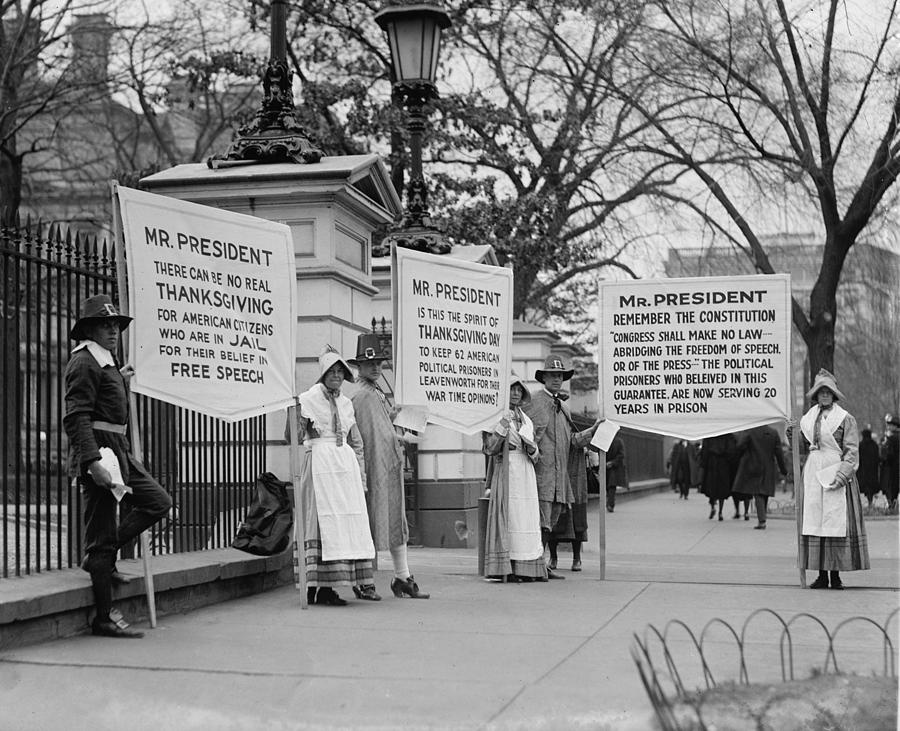
Wednesday, December 5, 2012
1(4). Roaring Twenties
A. POLITICAL
President Harding supported a renewed isolationism in reaction to World War I, a resurgence of nativism, and turning away from the government activism of the reform era. He created the Washington Naval Conference, which set limits on military build up around the world. He died of a heart attack that some believe to be the result of stress put on him from scandals he was allegedly involved in.
Calvin Coolidge was inaugurated after Harding's death. He made radio history for being the first president to have his inauguration broadcast on the radio. He was also the first president to make a political speech via radio. The last president of the twenties, Herbert Hoover, had to deal with the Wall Street Crash of 1929.
B. SOCIAL
 In 1920, the 19th Amendment was passed, allowing women to vote and giving them the equality they were fighting for. They were allowed to work in chemical, automobile, and iron & steel manufacturing industries.Women became more powerful and independent.
C. ECONOMIC
When President Warren Harding took office in 1921, the national economy was in the depths of a depression with an unemployment rate of 20%. Harding signed the Emergency Tariff of 1921 and the Fordney–McCumber Tariff of 1922. He proposed to reduce the national debt and taxes, protect farming interests, and cut back on immigration. These policies led to the "boom" of the Coolidge years. One of the main initiatives of both the Harding and Coolidge administrations was the rolling back of income taxes on the wealthy which had been raised during World War I. It was believed that a heavy tax burden on the rich would slow the economy and actually reduce tax revenues.
D. TECHNOLOGY

E. CULTURE

President Harding supported a renewed isolationism in reaction to World War I, a resurgence of nativism, and turning away from the government activism of the reform era. He created the Washington Naval Conference, which set limits on military build up around the world. He died of a heart attack that some believe to be the result of stress put on him from scandals he was allegedly involved in.
Calvin Coolidge was inaugurated after Harding's death. He made radio history for being the first president to have his inauguration broadcast on the radio. He was also the first president to make a political speech via radio. The last president of the twenties, Herbert Hoover, had to deal with the Wall Street Crash of 1929.
B. SOCIAL

C. ECONOMIC
When President Warren Harding took office in 1921, the national economy was in the depths of a depression with an unemployment rate of 20%. Harding signed the Emergency Tariff of 1921 and the Fordney–McCumber Tariff of 1922. He proposed to reduce the national debt and taxes, protect farming interests, and cut back on immigration. These policies led to the "boom" of the Coolidge years. One of the main initiatives of both the Harding and Coolidge administrations was the rolling back of income taxes on the wealthy which had been raised during World War I. It was believed that a heavy tax burden on the rich would slow the economy and actually reduce tax revenues.
D. TECHNOLOGY

Cars started to become mass produced instead of being a luxury. Radio became the first mass broadcasting medium. They were expensive but worth it. Electrical recording (sound recording) became available.

The late 1920s saw the emergence of Walt Disney. Mickey Mouse made his debut in "Steamboat Willie" on November 18, 1928 at the Colony Theater in New York City. Mickey would go on to star in more than 120 cartoon shorts, not to mention starring in the Mickey Mouse Club, and other specials.
Monday, December 3, 2012
4(3). Ramifications of WWI
A. Political
World War I hugely affected US politics due to the ratification of the nineteenth amendment, which gave women equal rights as men as a result of their wartime effortsB. Economic
As a result of the US joining WWI in 1916, industry production in America boomed. Many new departments were created during WWI. The Council of National Defense was created, the Fuel Administration for rationing, the Failroad Admin for rail traffic, the Food Admin. to increase agriculture production.C. Social
More employment opportunities opened for women and African-Americans, and women became the main employees of factories.1(3). US as a world power in the 20th century
The United States was a huge world power in the 20th century. They helped out many countries during WWI and eventually helped end the war.
American Enters WWI
2(3). Open Door Policy

Wednesday, November 28, 2012
3(3). Spanish- American War
Crucible of Empire: The Spanish-American War
The Spanish-American War of 1898 lasted only a few months. It resulted in a U.S. victory that not only ended Spain's colonial rule in the Western Hemisphere but also marked the emergence of the United States as a world power, as it acquired Puerto Rico, the Philippines, and Guam. Theodore Roosevelt's military exploits in Cuba catapulted him onto the national stage and led to the vice presidency and, ultimately, the presidency.The conflict had its origins in Spain's determined effort in the 1890s to destroy the Cuban independence movement. As the brutality of the Spanish authorities was graphically reported in U.S. newspapers, especially Joseph Pulitzer's New York World and William Randolph Hearst's New York Journal, the U.S. public began to support an independent Cuba.
Source
Monday, November 26, 2012
6(2). Progressives
A person advocating or implementing social reform or new, liberal ideas
Goals of the Progressive Party:
Goals of the Progressive Party:
- The desire to remove corruption and undue influence from government through the taming of bosses and political machines
- the effort to include more people more directly in the political process
- the conviction that government must play a role to solve social problems and establish fairness in economic matters.
5(2). The Effect of the Americanization Movement

4(2). Populists
pop·u·list
A member of the Populist Party, a US political party formed in 1891 that advocated the interests of labor and farmers, free coinage of silver, a graduated income tax, and government control of monopolies
noun /ˈpäpyələst/
|
A member of the Populist Party, a US political party formed in 1891 that advocated the interests of labor and farmers, free coinage of silver, a graduated income tax, and government control of monopolies
Monday, November 19, 2012
3(2). Social Darwinism
Social Darwinism is an ideology based upon the evolutionary theories of Charles Darwin, it justified the concentration of wealth and lack of governmental protection of the weak through the ideas of natural selection and survival of the fittest. (web definition) It has been used to justify eugenics (selective breeding for human improvement) programs aimed at getting rid of unwanted genes from the population. The American eugenics movement was popular between about 1910-1930, during which 24 states passed sterilization laws and Congress passed a law restricting immigration from certain areas considered to be unfit.


2(2). Growth Of Cities
Immigrants from around the world came to America for freedom. They occupied cities and added culture to America. Immigrants were required to take a citizenship test in order to become a citizen. They also underwent several health checks before being allowed to enter the country.


1(2). Rural to Urban Migration
In the 1800s, large groups of Americans migrated to the cities. When the population shifts from rural to urban (city) areas, it is called urbanization. There were pros and cons to this event. Because of the high demand for housing in the city, it was constructed quick and cheap. This also brought about unsanitary conditions. Soon these problems were fixed. There were many cultural oppurtunities and technological advancements, such as steel elevators and public transportation.


Thursday, November 15, 2012
6. Bill of Rights
The Bill of Rights are the first ten amendments of the US Constitution and they proctect the natural rights of liberty and property.
Transcript

Image
The First Amendment
Transcript

Image
The First Amendment
Congress shall make no law respecting an establishment of religion, or prohibiting the free exercise thereof; or abridging the freedom of speech, or of the press; or the right of the people peaceably to assemble, and to petition the Government for a redress of grievances.
5. The Civil War
Abraham Lincoln and the Civil War
The American Civil War was between the North (Union) and South (Confederates) over states' rights vs. federal authority, expansion in the West and slavery. It lasted four years and was the bloodiest war in American history.Click here for cool pictures from the Civil War
Subscribe to:
Posts (Atom)